.svg)


Psychodrama therapy is a group-based method that uses guided action and role play to work through unresolved experiences rather than only discussing them. Developed by Jacob Moreno, it puts a situation into physical enactment in the room. Clients often reach material in one session that talk therapy circles for months.
How Does a Psychodrama Session Work?
One group member, called the protagonist, works on a specific situation while other members take on roles within it. The director, a trained clinician, guides the enactment.
Five roles structure the work.
- Protagonist: the person whose situation is being explored.
- Director: the clinician guiding the process.
- Auxiliary egos: group members playing people or parts of the protagonist’s world.
- Audience: remaining members who witness and later share.
- Stage: the defined physical space where the action occurs.
What Are the 3 Phases of a Session?
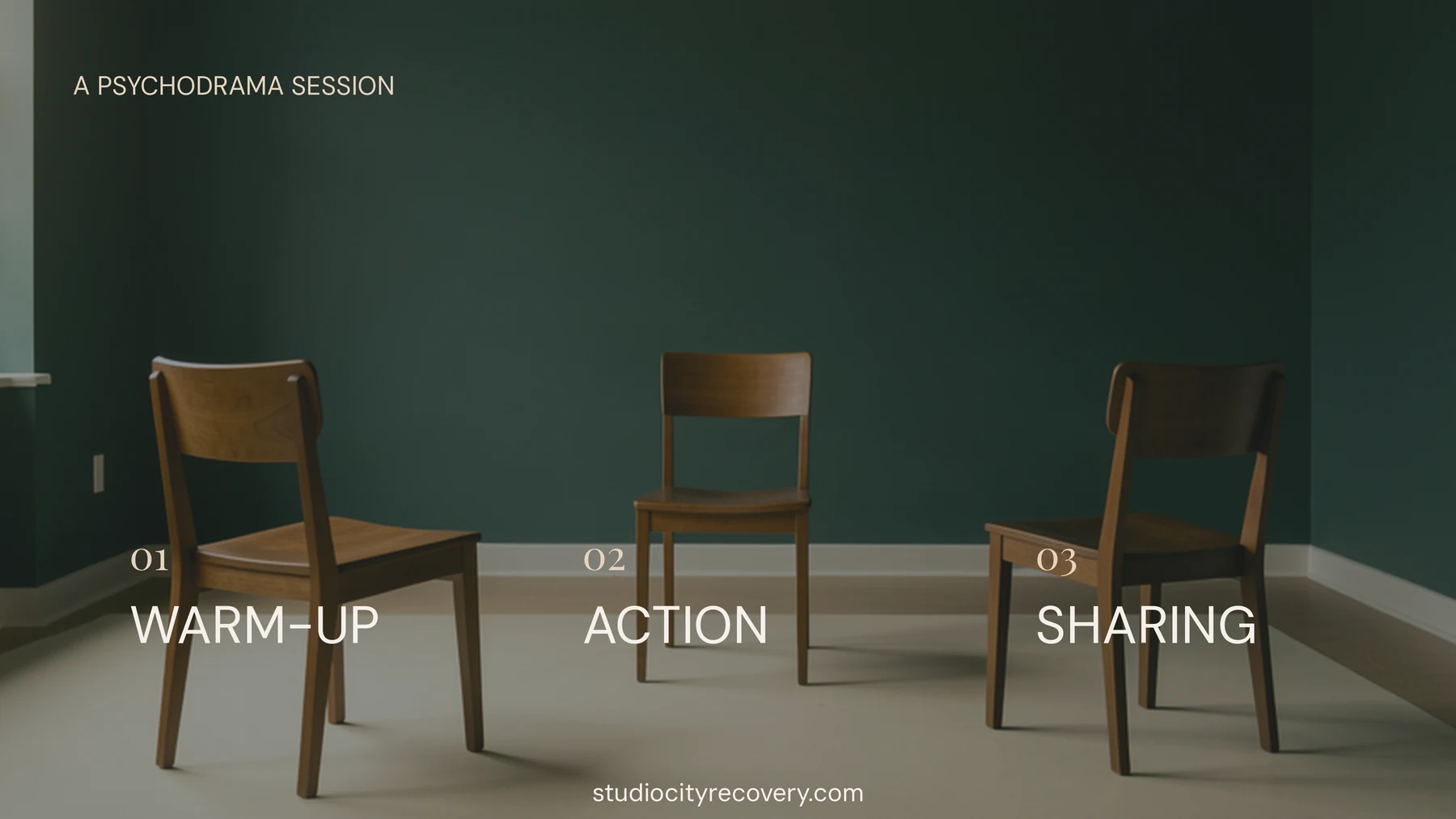
Sessions follow a consistent 3-phase arc.
- Warm-up: the group builds safety and a protagonist and theme emerge.
- Action: the situation is enacted, with the director introducing techniques as needed.
- Sharing: the group reflects on what surfaced in themselves, without analysis of the protagonist.
The sharing phase is protective by design. Members speak about their own experience rather than interpreting the protagonist’s, which keeps the process from becoming exposure without support.
What Techniques Are Used?
Four techniques appear in most sessions.
- Role reversal, where the protagonist plays the other person in the scene.
- Doubling, where a group member voices what the protagonist is not saying.
- Mirroring, where the protagonist steps out and watches the scene played back.
- Empty chair, where the protagonist addresses someone who is not present.
Role reversal produces the most consistent shifts, since standing in another position changes what a person can see about their own.
Why Is It Used in Addiction Treatment?
Addiction treatment involves relationships, unfinished conversations, and grief that discussion alone often fails to reach. Psychodrama gives those a form.
Four applications are common.
- Addressing a family member who has died or is unavailable.
- Rehearsing a difficult conversation before having it.
- Working with the internal conflict between the part that wants to use and the part that does not.
- Processing shame that has never been spoken aloud.
The internal conflict application is distinctive. Externalizing both sides into chairs makes ambivalence visible in a way that self-report rarely does.
What Does It Feel Like to Participate?
Most clients describe the first session as uncomfortable and the effect as unexpected. Discomfort comes from acting rather than talking, and it usually fades within one session.
Three experiences are reported consistently: reaching emotion faster than expected, gaining a different view of another person through role reversal, and feeling less alone during the sharing phase when others recognize their own material.
Who Is It Appropriate For?
Psychodrama suits clients who are stable enough to tolerate emotional activation with group support. Two groups need screening: clients in acute psychosis or severe dissociation, and clients whose trauma has not been stabilized.
Participation is voluntary in every session. Group members can witness without taking a role, and that remains clinically valuable.
How Does It Fit With Other Group Work?
Psychodrama supplements rather than replaces process groups and skills groups. Its role is depth on a specific situation rather than ongoing weekly support.
Standard group process is explained in how does group therapy work, and structural approaches within groups appear in what is subgrouping in group therapy. Program details are on our group therapy page.
Frequently Asked Questions
Do you have to act if you join a psychodrama group?
No. Participation is voluntary, and members can witness from the audience. Witnessing produces real therapeutic effect, and many clients take a role only after several sessions.
Is psychodrama the same as role play?
Role play is one technique within psychodrama. The full method includes the group structure, the 3-phase arc, and specific techniques such as doubling and mirroring.
Is psychodrama evidence based?
Research support exists, with published studies and meta-analyses reporting benefit across several presentations. The evidence base is smaller than that of CBT or DBT.
How large is a psychodrama group?
Groups typically run 6 to 12 members. That range provides enough people to fill roles while keeping the sharing phase manageable within a session.