.svg)


Motivational interviewing is a collaborative counseling style that helps a person resolve their own ambivalence about changing substance use. It replaces confrontation with guided conversation. The clinician does not argue for change, because arguing reliably produces resistance rather than movement.
Why Does Confrontation Backfire?
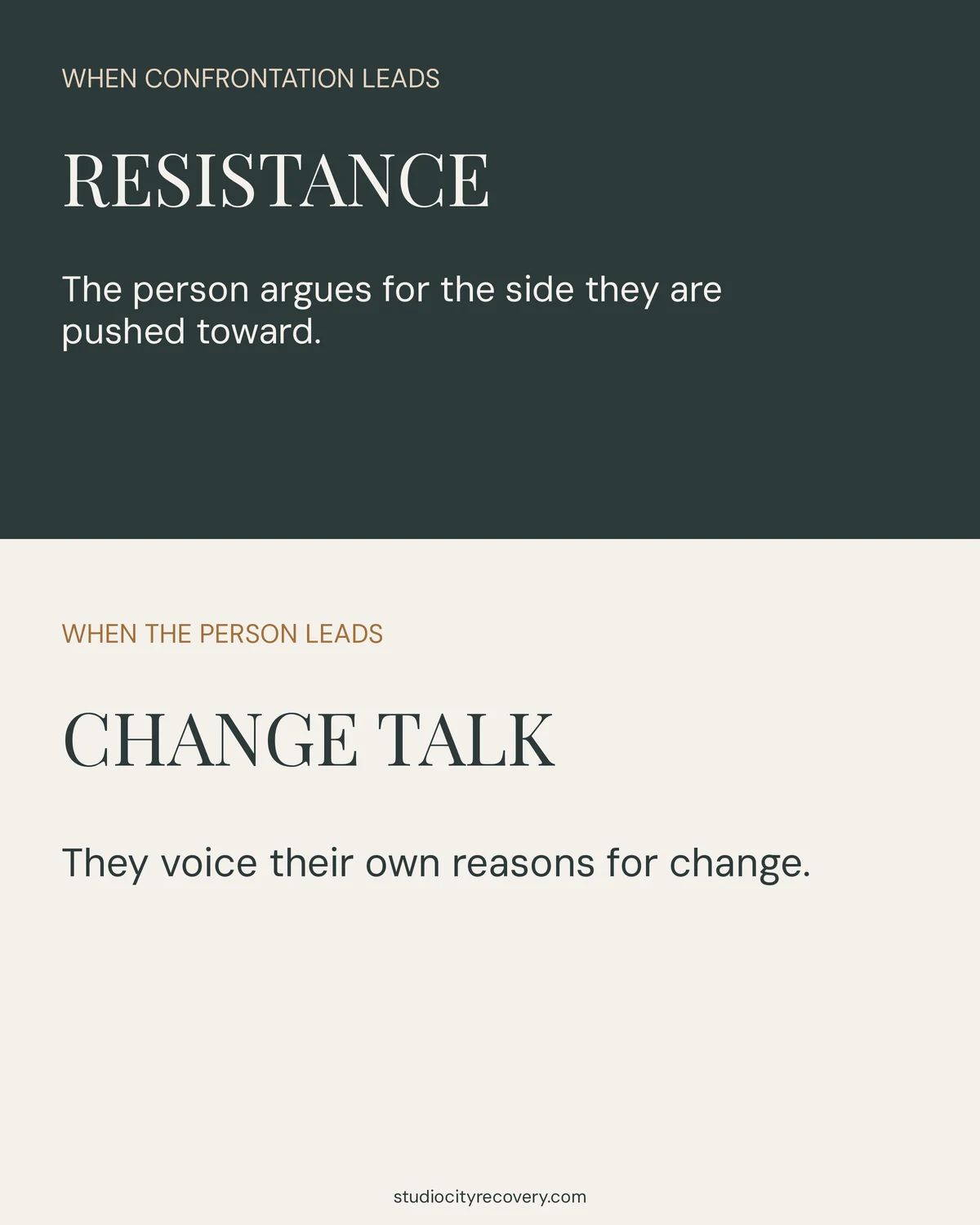
People argue for whichever side of an argument they are pushed away from. When a clinician or family member argues for quitting, the person naturally voices the reasons to continue, and hearing themselves say those reasons strengthens them.
Motivational interviewing reverses that dynamic by getting the person to voice their own reasons for change.
What Are the 4 Processes?
The method moves through 4 sequential processes.
- Engaging: establishing a working relationship before anything else.
- Focusing: identifying which change the conversation is about.
- Evoking: drawing out the person’s own motivations and reasons.
- Planning: developing concrete steps once readiness appears.
Skipping to planning is the most common error. A plan built before evoking has no motivation behind it and typically collapses within days.
What Are the OARS Skills?
Four core skills carry the conversation, remembered as OARS.
- Open questions that invite elaboration rather than yes or no answers.
- Affirmations that recognize specific strengths and efforts.
- Reflective listening that restates meaning to deepen the conversation.
- Summaries that gather what has been said and hand it back.
Reflective listening does the heaviest work. A well-placed reflection often produces more movement than any question.
What Is Change Talk?
Change talk is any statement the person makes favoring change, and evoking it is the central task. Five categories appear.
- Desire: I want things to be different.
- Ability: I could probably stop if I decided to.
- Reasons: my kids notice when I drink.
- Need: I have to do something about this.
- Commitment: I am going to call tomorrow.
Commitment language predicts behavior change most reliably, and it typically appears only after the other 4 have been voiced.
How Is It Used in Addiction Treatment?
Motivational interviewing is used most heavily at 4 points in care.
- Initial engagement, before a person has decided to enter treatment.
- Early treatment, when ambivalence remains active.
- After a return to use, where shame often drives disengagement.
- Aftercare planning, when the structure of a program falls away.
Recognizing a problem is often the first hurdle, and that process is discussed in identifying an addiction.
What Does the Clinician Avoid?
Four moves reliably shut down change talk, and clinicians are trained to avoid them.
- Warning about consequences the person has already heard.
- Offering solutions before the person has asked for them.
- Labeling, including the word denial.
- Taking the side of change and leaving the person to argue the other side.
Recognizing these moves is also the fastest way for a family member to change an unproductive dynamic at home.
Can Families Use These Skills?
Yes, and families benefit substantially. The core shift is to stop supplying arguments for change and start asking questions that let the person supply their own.
Families frequently need to address their own patterns at the same time. Practical guidance appears in how to stop enabling a family member’s addiction.
Individual sessions are where these conversations most often happen in treatment. Our individual therapy page outlines how one-to-one work is structured.
Frequently Asked Questions
Is motivational interviewing evidence based?
Yes. It has been studied extensively across substance use, medication adherence, and health behavior change, and it is among the more thoroughly researched counseling approaches in addiction treatment.
How long does it take to work?
Brief interventions of 1 to 4 sessions produce measurable change in some studies. In residential treatment it functions as an ongoing conversational style rather than a fixed course.
Does it work if someone is court mandated?
Yes. It is used frequently with mandated clients, and the approach is well suited to situations where external pressure exists, since it separates the clinician from the role of enforcer.
Is it the same as being permissive?
No. The clinician holds a clear direction toward change and simply does not argue for it. Reflecting a person’s ambivalence accurately is not agreement with continued use.