.svg)


Behavioral activation is a cognitive behavioral technique that treats depression by scheduling meaningful activity before motivation returns rather than waiting for it. It reverses the standard assumption that feeling comes first. Action produces the mood change, not the other way around.
Why Does Waiting for Motivation Fail?
Depression creates a self-reinforcing loop. Low mood reduces activity, reduced activity removes sources of reward, and the absence of reward deepens the low mood.
Motivation is a product of that loop, not an input to it. Waiting for it to return before acting keeps the cycle intact indefinitely.
What Are the 5 Steps of Behavioral Activation?
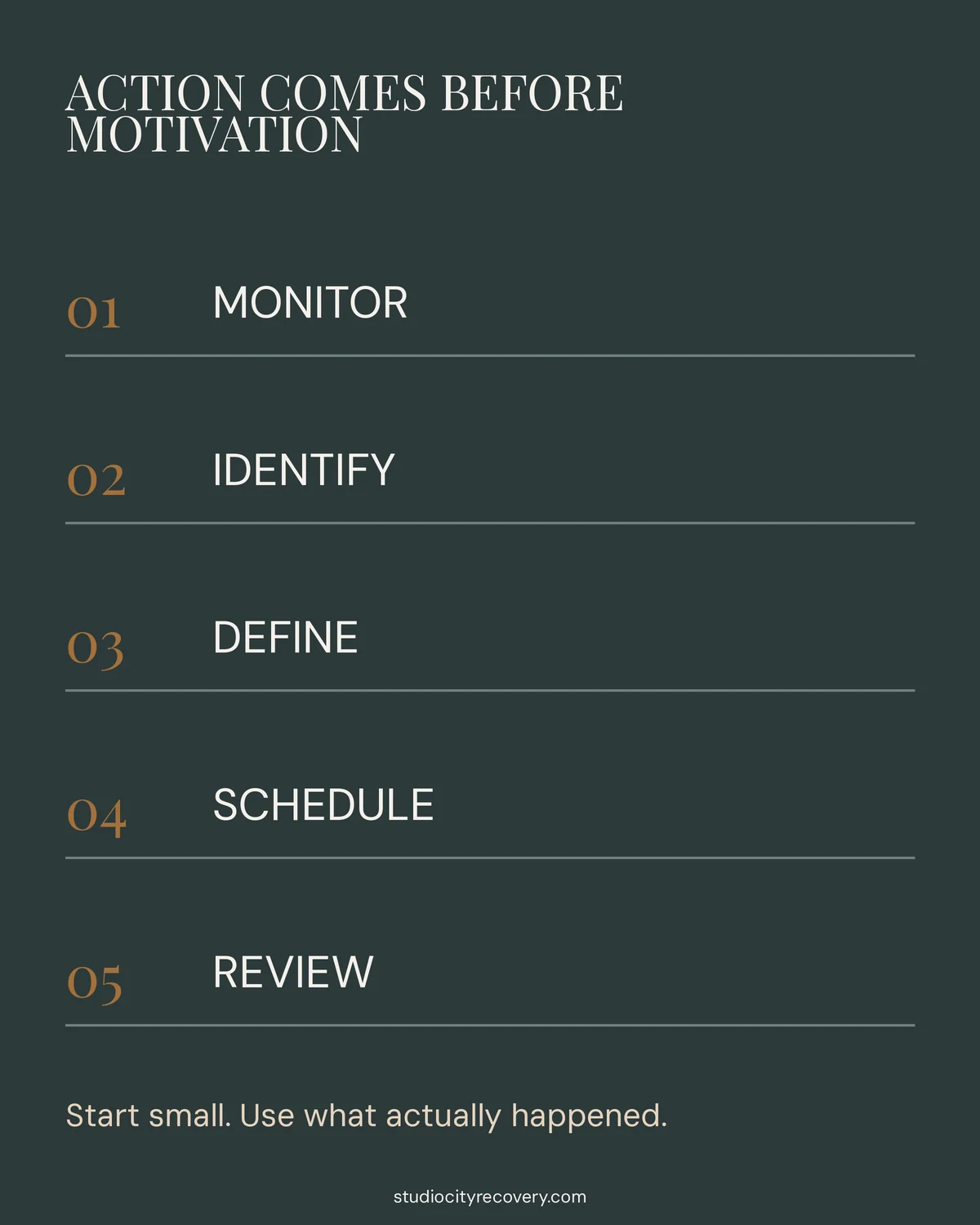
The technique follows 5 steps.
- Monitor current activity and mood across a full week.
- Identify which activities correlate with better and worse mood.
- Define values in specific life areas such as relationships, health, and work.
- Schedule activities tied to those values, starting small and specific.
- Review, adjust, and expand based on what actually happened.
Step 1 is skipped most often and matters most, since people consistently misremember which activities helped.
What Makes a Good Scheduled Activity?
Four qualities distinguish activities that work from ones that get abandoned.
- Specific: walk 15 minutes at 8 AM, not exercise more.
- Small: sized to a bad day, not a good one.
- Values linked: connected to something the person actually cares about.
- Scheduled: assigned a time and place rather than a general intention.
Activities that feel too easy are the right size at the start. Ambitious plans produce a single strong day followed by a week of avoidance.
What Are the 2 Kinds of Reward?
Behavioral activation targets 2 categories deliberately.
- Pleasure activities that produce enjoyment directly.
- Mastery activities that produce a sense of competence or accomplishment.
Depression erodes both, and plans built on pleasure alone tend to stall. Mastery activities such as completing a task or fixing something often shift mood more reliably in early recovery.
Why Does It Matter in Addiction Recovery?
Early recovery removes the primary source of reward and leaves a structural gap. Days that were organized around use become unstructured, and unstructured time is the highest-risk condition in early sobriety.
Three functions behavioral activation serves in that period.
- Rebuilding daily structure with defined activity.
- Restoring natural sources of reward as the brain recalibrates.
- Treating co-occurring depression, which is common in early recovery.
Related cognitive work appears in CBT exercises that help in early recovery.
What Gets in the Way?
Four obstacles account for most stalled attempts, and each has a specific fix.
- The activity was too large, so reduce it until it is almost trivially easy.
- The activity was not scheduled, so assign a day, time, and location.
- The plan relied on pleasure alone, so add a mastery activity.
- The week was reviewed only for compliance, so review for mood data instead.
A missed week is expected and is not evidence the approach failed. Restarting at a smaller size is the standard response rather than abandoning the plan.
How Does It Differ From Cognitive Restructuring?
Cognitive restructuring changes thinking to change behavior. Behavioral activation changes behavior to change thinking and mood, and it works well for people who find thought work difficult during acute depression.
Both are used together in most treatment plans. Thought-level work is covered in challenging negative thought patterns in recovery, and program structure is outlined on our cognitive behavioral therapy page.
Frequently Asked Questions
How long does behavioral activation take to work?
Many people notice mood change within 2 to 4 weeks of consistent scheduling. Research has found it comparable to other established depression treatments over a full course.
What if the activity does not improve mood?
That result is still useful data. The point of monitoring is to identify what actually helps, and activities that produce no change get replaced rather than repeated.
Is behavioral activation only for depression?
It was developed for depression and is applied broadly to anxiety, substance use recovery, and any presentation involving withdrawal from daily life.
Can you do it without a therapist?
The core structure can be self-directed with a worksheet. A clinician helps most with values clarification and with troubleshooting the weeks where nothing gets done.